
Building Active Life Communities for Older Adults by Promoting Smartphone Use
Hiroyuki Shimada
Director, Center for Gerontology and Social Science (CGSS), Research Institute, National Center for Geriatrics and Gerontology (NCGG)
Ryo Yamaguchi, Daiki Yamagiwa, Shoma Akaida, Osamu Katayama
Department of Preventive Gerontology, CGSS, Research Institute, NCGG
Introduction
As digitalization progresses in society, including the widespread adoption of smartphones and the advancement of network sophistication, the role of information and communication in the lives of citizens and economic activities is increasing1. Digitalization has the potential to significantly enhance the productivity and convenience of local communities, improve industries and quality of life (QOL), and enhance the attractiveness of regions.1 While the smartphone ownership rate among older adults is reportedly 93% for those in their 60s and 79% for those in their 70s,2 the smartphone and tablet utilization rate among those in their 70s and older is only 48.4%,3 thus highlighting the lingering issue of how to improve utilization rates among older adults. In a public opinion survey on the use of ICT reported by Japan's Cabinet Office, responses to a question on reasons for not using a smartphone included "I have no need for it in my life" and "I don't know how to use one."3 In order to increase the smartphone utilization rate among older adults, it is important to create multi-generational local communities and to provide appropriate information and technical training on how to use smartphones through local channels.
To this end, our project involved training local volunteers (herein "digital health promoters" or "DHPs") to promote the use of smartphones among older adults in order to build active life communities that support more engaged lifestyles in older adults through the use of smartphone applications (herein "apps"). We then studied the effect of smartphone app use on extending their healthy life expectancy.
Project Objectives
Google.org established the following five target outcomes for this project:
(1) The creation of 100 local communities in 50 municipalities; (2) The participation of 4,500 older adults in these communities to learn digital skills with young people; (3) A minimum 6-month continuous community participation rate of at least 13% (600 people) of all older adult participants; (4) Participant reported outcomes (PROs) indicating that these communities were beneficial and increased their confidence in digital skills among 70% of all older adult participants; and (5) PROs of improved well-being/QOL after participating in the program among 60% of all older adult participants.
The "Online Kayoinoba App"
In this project, the National Center for Geriatrics and Gerontology (NCGG) developed and released the "Online Kayoinoba App" (literally "online meeting place app"; herein "Kayoinoba app") free of charge.4 The Kayoinoba app not only allows users to combine physical, social, and cognitive activities, but also to self-manage records of their daily activities and to share these records with family and friends. By using the Kayoinoba app, older participants attempted to improve their activity levels and their digital skills.
Target Outcome 1: Creation of 100 local communities in 50 municipalities
In the first year of the project, we signed research agreements with several local governments with a focus on training DHPs and promoting the use of the Kayoinoba app in order to build a foundation for collaboration with these municipalities. We then trained the DHPs in these municipalities to support older adults in learning digital skills, and began promoting community-based use of the app and rolling out smartphone classes. In preparation for the training workshops, we prepared and used a basic smartphone operating manual explaining tasks such as powering up the device, and an applied operating manual explaining tasks such as how to use the camera. We then collaborated with the municipalities to train the DHPs, dispatching lecturers and the municipalities recruiting participants to become DHPs and arranging the venues for training sessions. At the training workshops, the DHP learned the key points required to support older adult participants while actually operating a smartphone.
In the project's second year, we expanded the scope of the DHP training to include other regions. The trained DHPs held smartphone classes in various regions with a focus on using the Kayoinoba app.
These efforts contributed significantly to the creation of local communities. Over the course of this 2-year project, we trained 216 DHPs and created 138 local communities in 64 municipalities through DHP-led community activities.
Target Outcome 2: Community participation of 4,500 older adults to learn digital skills with young people
During the first and second years of the project, we promoted the use of the Kayoinoba app by developing a framework to facilitate its use by municipalities. Specifically, we published a pamphlet introducing the app and a manual on how to use it, and launched an introductory website and explanatory videos, all free of charge. In addition to these media, we implemented measures to promote the use of the Kayoinoba app by placing advertisements on cable TV and in newspapers with the aim of enabling older participants to proactively self-manage their health and activities. The DHPs worked with local governments to provide smartphone classes using the Kayoinoba app as content at community organizations, so-called "salons" (communal gatherings for older adults), and community centers, thus making it easy for anyone to understand and develop an interest in the app. As a result of these activities, we received inquiries from several municipalities nationwide to use and promote the Kayoinoba app. In response, we held training sessions for DHPs via web meetings and undertook other initiatives to promote the nationwide development of the app, thereby contributing extensively to efforts to bridge the digital divide for older adults and maintain and improve their activity levels.
We also established a support system for activities promoting the use of the Kayoinoba app by enlisting the cooperation of private companies. This initiative enabled the development of an ongoing support system whereby companies held follow-up sessions for the smartphone classes conducted by DHPs. Some local governments even requested cooperation from local high school students as a way to engage young people in the project, and created systems to facilitate support for the project from the DHP training process (Fig.).
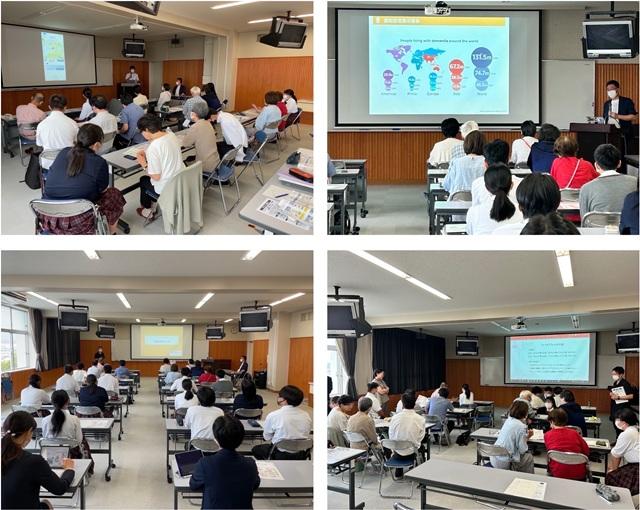
Through these activities conducted over the 2-year project period, the number of older adults who participated in the digital skills learning program with a focus on the Kayoinoba app reached 5,073 people.
Target Outcome 3: Minimum 6-month continuous community participation by ≥600 older adults
We conducted a classroom-based intervention program in order to examine how participation in the created communities impacted the mental and physical functions of older participants through continued adoption of digital technology. Program participants were recruited from a cohort study of approximately 2,000 community-dwelling older adults, 652 of whom consented to participate in a classroom-based community and had no progressive or other diseases that might interfere with their continued participation.
In the first year of the project, before commencing the classroom-based intervention, we conducted a pre-intervention evaluation of these participants, including cognitive and physical function assessments, interview on their lifestyle habits and psychological status, and blood tests. Some of the participants did not initially own a smartphone, so DHPs were assigned to the community to provide digital skills support and mitigate participant anxiety. We also implemented various initiatives to improve adherence in order to maximize the effectiveness of the intervention. These initiatives included setting goals suited to the participant's lifestyle, such as opening the Kayoinoba app every day and using a Kayoinoba app function every day, and providing incentives to participants who achieved these goals. To alleviate participants' hesitancy or reluctance to use the Kayoinoba app, we sought participant opinions about the app and made a number of improvements over time to the user interface and user experience to enhance usability and operability.
While the target population of interventional studies is often set based on an assumed participant dropout rate of around 15%, we managed to minimize the number of dropouts from the classroom-based intervention through the use of various initiatives, with 611 (93.7%) of the 652 participants completing the post-interventional evaluation. More than 600 older adults continued participating in the community for a period of 6 months.
Target Outcome 4: PRO of increased confidence in digital skills after community participation among 70% of older adult participants
In this project, we created classroom-based communities and conducted community interventions in the form of digital skills learning. In this intervention, a total of 611 older adults continued the digital skills learning using the Kayoinoba app as the primary learning tool. The participants were 611 males and females in their 60s to 80s, of whom 196 (32.1%) participants were given a smartphone as part of the interventional program to promote their use of digital technology. These 196 participants also included older adults who, as a result of participating in the interventional program, subsequently purchased their own smartphone during or after the intervention and continued using them.
In the post-interventional survey conducted after completion of the interventional program, 358 (58.6%) of the 611 participants responded that they were more confident in their digital skills compared to before the program. We then performed detailed analyses of the assessment results based on the factors of age, sex, and whether or not the participant received a smartphone as part of the interventional program. The findings of our analyses showed that the percentage of participants who felt more confident in their digital skills was highest among females in their late old age (≥75 years) who had received a smartphone as part of the interventional program, at 72.5%. On the other hand, approximately 50% of both the participants who already owned their own smartphone and the male participants indicated that they felt more confident in their digital skills as a result of the interventional program. The fact that the percentage of participants in this interventional program who reported feeling more confident in their digital skills did not reach 70% may have been because the digital skill learning curriculum was not set at a high level in consideration of those participants who did not own their own smartphone. In other words, the participants who already owned a smartphone may not have learned any new skills as they were already knowledgeable of the content. Despite not achieving the 70% target for all participants, a result of 70% or higher was achieved among participants with certain characteristics. These findings also highlighted the need for individually tailored interventions in addition to group-based interventions.
Target Outcome 5: PRO of improved well-being/QOL after community participation among 60% of older adult participants
In the classroom-based intervention, we also assessed improvements in well-being/QOL. Of the 611 participants, 540 (88.4%) responded that their well-being had improved, and 496 (81.2%) responded that their QOL had improved. By sex, a higher percentage of female participants reported improved well-being and/or improved QOL than male participants. Participants in the classroom-based communities provided positive feedback such as "It was innovative and enjoyable,""I could understand the app," and "I had the opportunity to interact with various people." The program also strengthened community connections, with participants who had a certain degree of smartphone skills teaching those who were unaccustomed to using a smartphone, thereby promoting opportunities for their interaction and creating roles for both sides. We attributed the >80% improvement in both well-being and QOL to the program's success in promoting participant encounters and interactions and creating roles.
Issues & Countermeasures
The DHPs that we trained in collaboration with municipalities provided digital skills learning to older participants via the Kayoinoba app. By setting appropriate goals and providing incentives, we identified the potential for developing sustained connections to digital technology among older adults. However, incentives that involve costs represent a barrier to this continuity due to the financial burden on the organizations that fund them. In terms of setting goals, it may be difficult to bring about target-oriented behavioral changes in older adults without the presence of staff and other personnel who understand these individuals and their connections to those around them.
The key insight of this project is that many older adults have trepidation and anxiety about what they do not know, and are unwilling to attempt things beyond what they have learned. This tendency was particularly pronounced among the female participants and those in their late old age. The project demonstrated the importance of not only learning how to operate smartphones and other digital devices, but also learning about the potential hazards and benefits of digital technologies while improving digital literacy. The project also showed that older adults are capable of using digital technologies effectively if they receive the correct knowledge and skills.
Assigning roles such as teaching digital skills fostered a sense of individual fulfillment, and those who were taught subsequently developed into those who taught. Continued participation in the classroom-based community and sustained learning of digital skills also led to the formation of not only direct face-to-face interactions but also non-face-to-face interactions through the Kayoinoba app.
Acknowledgments
This project was conducted under the auspices of the "Grant for Research on Solutions to Aging Society Issues and Activities for Social Implementation" sponsored by Google.org, which is the philanthropic arm of Google, and the Japan Foundation for Aging and Health (Principal Investigator: Hiroyuki Shimada).
References
- Ministry of Internal Affairs and Communications. 2024 White Paper on Information and Communications in Japan. https://www.soumu.go.jp/johotsusintokei/whitepaper/ja/r06/pdf/index.html. Accessed Mar 24, 2025.
- NTT Docomo Mobile Society Research Institute: Mobile Society White Paper 2024. https://www.moba-ken.jp/whitepaper/wp24.html. Accessed Mar 24, 2025.
- Cabinet Office. Public Opinion Survey on the Use of Information and Communication Devices (Jul 2023), CAO Public Opinion Survey Report. https://survey.gov-online.go.jp/hutai/r05/r05-it_kiki/#T2. Accessed Mar 24, 2025.
- Katayama O, Shimada H. The "Online Kayoinoba App" in Older Adults. Jpn J Clin Psych. 2025;67(1):89-95.
Author

- Hiroyuki Shimada
- Director, Center for Gerontology and Social Science (CGSS), National Center for Geriatrics and Gerontology (NCGG)
- Background
- 2003: PhD in Rehabilitation Sciences, Department of Clinical Medicine, Kitasato University Graduate School of Medical Sciences, Research Fellow, Tokyo Metropolitan Institute for Geriatrics and Gerontology (TMIGG); 2005: Visiting Researcher, Prince of Wales Medical Research Institute; 2006: Research Fellow, TMIGG; 2010: Director, National Center for Geriatrics and Gerontology (NCGG), (concurrent) Visiting Researcher, Graduate School of Medicine, Nagoya University; 2014: (current) Head of Department of Preventive Gerontology, NCGG; 2015: Visiting Professor, Institutes of Innovation for Future Society, Nagoya University; (concurrent) Specially Appointed Professor, School of Medicine, Shinshu University; 2019: (current) Director, Center for Gerontology and Social Sciences, NCGG; (concurrent) Visiting Professor, Doshisha University; 2023: (concurrent) Visiting Researcher, Institute of Physical and Chemical Research (RIKEN); 2024: (concurrent) Visiting Professor, Tokyo Metropolitan University
- Specialization:
- Rehabilitation medicine, gerontology