
Research Project on Creation of Job and Volunteer Opportunities and Implementation of Digital Matching―Toward a Society Where Everyone Can Play an Active Role
Hiroshi Murayama
Deputy Head of Research (Theme Leader), Research Team for Social Participation and Healthy Aging, Tokyo Metropolitan Institute for Geriatrics and Gerontology (TMIG)
Yuka Nakamura, Yu Nofuji, Kumiko Nonaka, Mai Takase, Naoko Saito, Takumi Suda
Research Team for Social Participation and Healthy Aging, Tokyo Metropolitan Institute for Geriatrics and Gerontology (TMIG)
Project Synopsis
The use of digital technologies is expected to further facilitate social participation of the older adults, including work and volunteer activities. However, issues such as the types and formats of work preferred by older adults, as well as the concerns of companies and community organizations regarding accepting older adults as employees or members (e.g., volunteers), have not been adequately researched. Consequently, effective strategies for utilizing digital technologies to match older adults with work and volunteer opportunities remain unclear.
In the present project, we sought to identify and systematically map the challenges in promoting the social participation of older adults and to explore the future potential of digital matching by: (1) conducting a survey for the older adults, and interviews for private companies and local organizations, and; (2) developing and implementing a system to promote work and volunteer activities among the older adults using an application (herein "app") in the three municipalities of Wako City in Saitama Prefecture, Hachioji City in Tokyo, and Itabashi Ward in Tokyo, collaborating with each municipal government.
Specifically, we aimed to create job and volunteer opportunities (herein collectively "jobs/vols") and to match older adults with these jobs/vols activities. We coined the original term "jobs/vols" that indicates "one-time, short-duration, and simple" jobs and volunteering that are specifically created to address challenges of older adults' social participation. Previous research presented the following challenges of social participation: "interpersonal relationships within organizations are bothersome," "I'm not confident in my physical abilities," and "I don't know what I will be expected to do."1,2 To address these challenges, we deconstructed routine tasks performed in companies and organizations and developed "jobs/vols," that is one-time, short-duration of simple assignments.
Implementation scheme:
We primarily targeted older adults who were actively participating in local activities in the cities of Wako and Hachioji, and older adults who were reluctant to participate in local activities in Itabashi Ward. Subsequently, coordinators were assigned to each field, and the following initiatives were undertaken: (1) promoting the app for potential users and recruiting them to jobs/vols; (2) engaging with companies and community organizations to develop jobs/vols opportunities; (3) matching older users to jobs/vols through the app (Fig.).
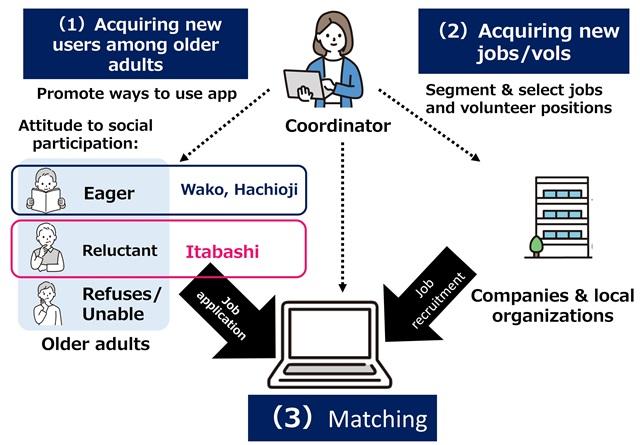
In Wako City, GBER (short for "Gathering Brisk Elderly in the Region") app, provided by Professor Atsushi Hiyama of the University of Tokyo and Hitotsubashi University, was utilized. In Hachioji City, the Braincure (or "Nou Ni Ii" in Japanese) app, provided by BSPR Inc., was employed. In Itabashi Ward, the GRANT app, provided by Certified NPO Service Grant Japan, was used. Although the specifications of each app differ slightly, they all follow a common "jobs/vols" procedure: a coordinator registers job or volunteer opportunities, and the app users search for and apply to them via the app.
Project Outcomes
1. Survey: Identifying the needs of older adults regarding jobs/vols activities and the challenges faced by companies and organizations
(1) Identifying the needs of older adults
In June 2023, we conducted a mail-in survey targeting all older adult residents of Wako City excluding those requiring Care Level 3 or above. We received responses from 6,430 residents, with a valid response rate of 46.0%. Based on the results of our subsequent cluster analysis, we classified the employment needs of the older adult into the following three categories: (1) Low-frequency/short-time skill-based employment (35%) comprising those who prefer to work less than 1-4 hours/day for 1-4 days/week, who prefer not to do physical work or simple tasks, who prefer to leverage their experience and skills, and who place importance on work deemed useful to people and society; (2) Low-frequency/short-time manual employment (26%) comprising those who prefer to work less than 1-4 hours/day for 1-4 days/week and who prefer simple tasks, and; (3) Medium-frequency/medium-time physical employment (39%) comprising those who prefer to work less than 4-7 hours/day for 3-4 days/week and who prefer physical work. We considered that the possibility of jobs/vols matching will be increased by preparing employment opportunities, which fulfilling these older adults' employment needs.
(2) Identifying challenges that companies face in hiring older workers and responses to those challenges
In April 2023, we conducted interviews with managers and administrators of five companies that employ older adults. We identified the "diminished physical strength" and "decline in cognitive functions" associated with aging were perceived as the key challenges in hiring older adults. In response, employers adjusted working hours and days to accommodate physical conditions and assigned support staff to verify the accuracy of older employees' work. However, companies regarded these measures as burdensome, as they required additional effort and resources.
2. Implementation: Promoting digital matching
(1) Wako and Hachioji fields
(a) Acquiring new older app users
To increase the number of registered app users, we disseminated information about the apps to the older residents and organized local government-led workshops on how to use the apps, held on as-needed basis. We also developed a system through which older adults can easily consult with coordinators when they encountered difficulties in the registration process. As a result, a total of 7,330 older adults have registered to apps in the two fields, as of December 31, 2024 (160 in Wako City and 7,170 in Hachioji City).
(b) Cultivating new jobs/vols
The coordinators conducted interviews with nursing care and childcare facilities, which faced labor shortages to identify the works/tasks in need of support. Based on findings, jobs/vols opportunities were created from these identified tasks. However, many of the proposed roles, such as cleaning and cooking assistance, were paid below the minimum wage, thereby posing a risk of inconsistency with the Labor Standards Act. As a consequence, coordinators could not post as jobs/vols, and most of jobs/vols opportunities offered were of a highly voluntary nature, such as playing Go (a Japanese board game) with patrons of an older day care facility (Table 1-1 and 1-2).
| Activity | Requesting Organization | Duration (hr) | Frequency | Remuneration |
|---|---|---|---|---|
| Cleaning floors and toilets, doing laundry | Certified childcare center | 2 hr | 2-3 days/week | Provided |
| Gardening | Certified childcare center | 1 hr | 2-3 days/week | Provided |
| Vacuuming shuttle vehicles | Day care facility | 1 hr | 1 day/week | ¥1,000 QUO card for 5 sessions |
| Cleaning washbasins and living areas | Short-stay facility | 1 hr | 1 day/week | ¥1,030 per time |
| Cooking assistance | Group home / Short-stay facility | 3 hr | 5 times/week | Lunch provided |
| Activity | Requesting Organization | Duration (hr) | Frequency | Remuneration |
|---|---|---|---|---|
| Companionship and conversation | Nursery school | 1-2 hr | Preferred day(s) | None |
(c) Matching
Coordinators posted available positions on the app and distributed updates to all registered users. In addition, coordinators also directly called specific registered users whose skills and job preferences may match with offered jobs/vols positions. As a result, a total of 638 individuals (89 in Wako and 549 in Hachioji) had been matched to 13,563 jobs/vols opportunities (470 in Wako and 13,093 in Hachioji) in the two fields as of December 31, 2024.
(2) Itabashi field
Previous study revealed that older adults who are reluctant to participate in community activities actually have a desire to be connected with local community, but hesitate to participate due to anxieties such as "I'm not confident that I can handle it" and "It's hard to understand the purpose and significance of the activities."3 Therefore, we attempted to match this segment (those who are reluctant to participate in community activities) with local community through jobs/vols, in collaboration with the Itabashi Council of Social Welfare. In order to attract this segment of older adults, we created advertisements for jobs/vols that emphasized the significance and purpose of each activity in the community. These advertisements were intended to evoke empathy and encourage jobs/vols participation.
(a) Acquiring new older app users
In order to reach those older adults who are difficult to access through conventional methods such as flyer distribution, we utilized internet-based advertising tools (e.g., Facebook, Instagram) to spread awareness of the jobs/vols activities.
(b) Cultivating new jobs/vols
We conducted workshops targeting local organization members on an as-needed basis. In these sessions, participants first listed their routine tasks and activities, which were then classified into two categories: "tasks/activities that could be delegated to others" and "tasks/activities that they should be carried out by themselves." From the first category, we cultivated jobs/vols activities consisting of one-time, short-duration, and simple tasks.
(c) Matching
We created recruitment messages highlighting the significance of each activity and recruited applicants through the app. Rather than simply asking the users to participate in jobs/vols activities due to organizational staff shortages, we crafted messages that clearly explained who would benefit from the jobs/vols activities and how they would contribute to the community. For example, in a jobs/vols recruitment article seeking applicants to tabulate questionnaires from a brain training session, we posted the following message: "At the end of the session we ask all participants to complete a questionnaire. By hearing the opinions of participants, we can make the experience even more satisfying for more people. We are therefore looking for people who can assist us in tabulating the questionnaires."
As a result of these efforts, 49 individuals were matched to a total of 80 jobs/vols activities as of December 31, 2024. After participating in the activities, we asked them to complete a survey to evaluate their experience, and 36 participants responded. Among these respondents, approximately 40% had no prior experience in community activities. In other words, we successfully recruited the target population of the project.
The most commonly reported motivations for participation were a desire to contribute to the community or help others (51%), and the appeal of short-duration commitments (43%). These results indicate that emphasizing the value of brief involvement and offering short-term opportunities can effectively engage individuals who are typically less involved in community activities.
(d) Post-matching support
On the day of the jobs/vols activities, coordinators accompanied the jobs/vols participants to the activity sites and worked collaboratively with the local organizations to welcome them and provide support, helping them become familiar with the environment. These efforts were intended to ensure that participants felt that they had contributed and enjoyed the jobs/vols. For instance, rather than providing top-down instructions, the coordinator took a more supportive and personalized approach such as working with the participant until they could successfully complete the task, asking the participant's idea about how to carry out the task, and adjusting the amount of work according to the participant's condition and skill level.
Remaining Challenges & Countermeasures
We identified challenges in promoting digital matching and proposed the recommendations, based on the results from above-mentioned survey for older adults, interviews with companies, jobs/vols participants (n=12), and coordinators (n=7).
1. Two barriers to app-based recruitment that need to be mitigated
Analysis of the interview data of job-vol participants revealed two barriers that older adults face when attempting to apply for jobs/vols opportunities through the app. The first barrier was digital in nature. Many older adults expressed concerns about fraud and the potential for unauthorized disclosure of personal information, and often found the registration process cumbersome. This perception was particularly common among those with low levels of digital literacy. The second barrier was the activity-related. Even among those with relatively high digital skills, uncertainty regarding the nature of the activity and the specific skills required led to hesitation and self-doubt about their ability to participate. However, these barriers were found to be mitigable through the support and encouragement of coordinators. Once older adults received reassurance and assistance, many were able to overcome their reluctance and proceed with the application process. These observations highlight the effectiveness of assigning coordinators as a strategy to promote digital engagement and social participation.
2. Legislation reforms enabling new types of activities are required to meet the diverse needs of the older adults
Due to the legal risk of inconsistency with the Labor Standards Act, it was not permitted to recruit older adults for paid-volunteer activities at private companies when the compensation was set below the minimum wage. Consequently, no participants were placed in such roles. As a result, most older adults were engaged as unpaid volunteers, and the variety of available job/volunteer roles was limited. However, findings from the aforementioned survey indicate that many older adults desire small-scale, low-responsibility, and non-remunerated work, provided that the activities are comfortable and appropriate to their abilities. This suggests that, in order to meet the diverse needs of older adults, new legislative frameworks are needed to create activity categories that are neither strictly classified as "work" nor as "volunteer" roles.
3. Fostering norms that promote employment of older adults is essential
Interviews for companies indicated a tendency to prefer younger over older workers. Furthermore, companies often viewed the need to assign additional staff to ensure the safety of older adult workers as a burden. These attitudes suggest that prevailing corporate norms do not yet sufficiently value the contributions of older adults in the workplace. In order to promote the employment of older adults in the future, it is essential to foster societal and organizational norms that recognize and promote the benefits of hiring them. Otherwise, efforts to expand job opportunities for older adults may face persistent structural resistance.
Conclusions
With the development of technology and the ever-increasing needs of the modern age, the matching of social participation activities for the older adults using digital technologies will undoubtedly be promoted in the future. Our implementation of digital matching in Wako and Hachioji demonstrated that there are certainly segments of the older population who can benefit meaningfully from digital matching systems.
Meanwhile, we also found that it is crucial to address systematic challenges, such as by reforming legislation to enable new forms of activities that meet the diverse needs of the older adults and that are neither a job nor volunteer work, and by fostering positive social norms regarding employment of the older adults. Furthermore, as demonstrated by the case in Itabashi City, where recruitment efforts targeted older adults who were reluctant to participate in the local communities, it is also important to adopt a deliberate approach to diverse older adults that reflects the gradations in their willingness and interest in participating in community activities. Without this approach, it would be difficult to realize a society in which no one is left behind or in which the older adults can play an active role, no matter what kind of wonderful digital technologies we use, and we may instead end up contributing to the social participation gap.
We believe that in order for Japan to become a leading country in terms of social participation, we must develop systems that are compatible with the diversity of society while also leveraging the benefits of digital technologies.
Acknowledgments
This project was conducted under the auspices of the "Grant for Research on Solutions to Aging Society Issues and Activities for Social Implementation" sponsored by Google.org, which is the philanthropic arm of Google, and the Japan Foundation for Aging and Health (Principal Investigator: Hiroshi Murayama). This report is based on excerpts from the grant-funded Outcomes Report.
References
- Cabinet Office. Annual Report on the Ageing Society FY2021. https://www8.cao.go.jp/kourei/whitepaper/w-2021/html/zenbun/s1_2_3.html. Accessed Mar 24, 2025.
- Nonaka K, Takase M, et al. Activity status of pro bono workers as the new leaders of community building and their advocating factors: Findings from interview surveys and questionnaires of active pro bono workers. Paper presented at: 65th Annual Meeting of the Japan Socio-Gerontological Society; June 17-18, 2004; Yokohama, Japan.
- Saito N, Nonaka K, Sugiyama M, et al. Factors preventing social interaction among socially isolated older adults: Findings from an interview survey. Paper presented at: 82nd Annual Meeting of the Japanese Society of Public Health; October 31-November 2, 2023; Ibaraki, Japan.
Author

- Hiroshi Murayama
- Deputy Head of Research (Theme Leader), Research Team for Social Participation and Healthy Aging, Tokyo Metropolitan Institute for Geriatrics and Gerontology (TMIG)
- Background
- 2009: Completed PhD in Health Science Nursing, Graduate School of Medicine, University of Tokyo; Specially Appointed Assistant Professor, Institute of Gerontology (IOG), University of Tokyo; 2010: Research Fellow, Research Team for Social Participation and Healthy Aging (RT-SPHA), Tokyo Metropolitan Institute for Geriatrics and Gerontology (TMIG) (to 2015); 2012: Visiting Fellow, University of Michigan School of Public Health (Uehara Memorial Foundation Postdoctoral Fellow) (to 2014); 2015: Specially Appointed Lecturer, IOG, University of Tokyo; 2020: Special Deputy Director, RT-SPHA, TMIG; 2021: Deputy Director (Team Leader), RT-SPHA, TMIG; 2023 to present: Current position (team name changed)
- Specialization:
- Public health, gerontology